By Loud Drip Staff
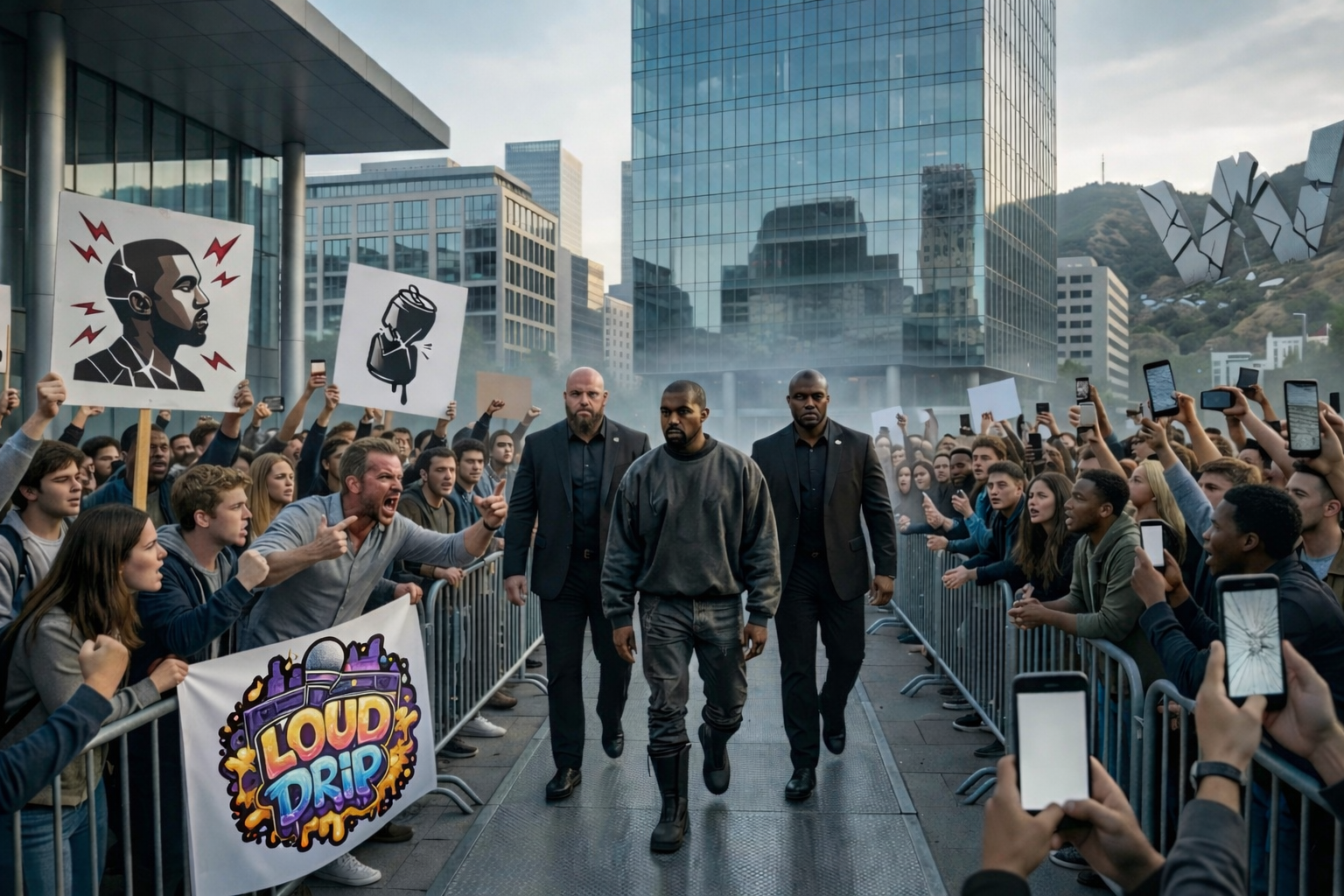
Ye festival backlash has turned Wireless Festival into a test case for what music events are willing to tolerate in exchange for attention. After the London festival booked Ye to headline in July, Pepsi and Diageo withdrew sponsorship while political leaders and Jewish organizations condemned the decision.
What we know / What to watch:
Ye is still listed as Wireless Festival’s headliner for all three nights in July, but the event has already lost Pepsi sponsorship and Diageo support amid escalating criticism. The next question is whether organizers hold the line, replace him, or face a deeper commercial and political rupture.
Ye festival backlash is no longer just about one controversial artist getting booked for a summer slot. It has become a wider argument about what major music festivals think a headline performance is worth, what corporate sponsors will still attach themselves to, and whether the live-music business really has moral red lines when a famous name can still move tickets. Wireless Festival’s decision to book Ye for all three nights of its July event in London has already triggered a sponsor retreat, criticism from U.K. political leaders and condemnation from Jewish community groups. Pepsi has withdrawn its sponsorship, Diageo has followed, and Prime Minister Keir Starmer called the booking “deeply concerning.”
What makes this bigger than ordinary celebrity outrage is that the objections are not based on vague bad behavior or standard scandal fatigue. The backlash is tied to Ye’s well-documented pattern of antisemitic rhetoric and public flirtation with Nazi imagery and praise for Hitler, which multiple outlets and critics referenced directly in condemning the booking. AP reported that pressure intensified after renewed attention to those past statements and actions, while The Guardian said Jewish leaders and public officials argued that giving him a premier London platform was reckless in the current climate.
The commercial fallout tells you this is not being treated like ordinary internet noise. This festival was long branded as “Pepsi Max presents Wireless”, which made Pepsi’s withdrawal especially significant. AP, Entertainment Weekly and The Guardian all reported that Pepsi pulled out after the booking came under national scrutiny, and The Guardian added that Diageo also stepped away. Sponsors do not abandon a major festival lightly, especially when their branding has been closely woven into its identity. When they do, they are signaling that the reputational risk has started to outweigh the audience benefit.
That is where the culture story sharpens. Festivals used to sell themselves mainly through lineup taste, exclusivity and scene credibility. Now they also function as value statements, whether organizers admit it or not. Booking Ye in 2026 is not neutral. It is a decision made in full view of years of prior controversy and after repeated public blowback tied to antisemitism. That means Wireless is not being judged only on whether Ye can draw a crowd. It is being judged on whether it believes controversy is simply another form of promotion.
There is also a strong London-specific dimension here. The Guardian reported that Mayor Sadiq Khan’s office condemned the booking, and AP said Keir Starmer publicly criticized it as well. This is not a case where backlash has stayed inside music journalism or activist circles. It has moved into mainstream political language because the event is happening in a city where public leaders are already sensitive to rising antisemitic incidents and to the symbolic force of who gets welcomed onto major stages. Once that shift happens, the booking stops looking like niche entertainment programming and starts looking like a civic controversy.
Ye’s defenders could argue that public life is full of imperfect people, that art and artist should be separated, or that a booked performance is not the same as endorsing every belief a performer has expressed. That argument is not new. What is new is how weak it looks once sponsors start leaving and political leaders begin speaking publicly. A festival can survive online criticism. It is much harder to breeze past the loss of blue-chip partners and the impression that the event’s leadership is out of step with the broader public mood.
The backlash also reveals a stubborn truth about Ye’s place in modern culture: he remains influential enough to create real commercial temptation even after years of behavior that alienated brands and institutions. That is part of why this story is so uncomfortable. If he were easy to ignore, the booking never would have happened. Wireless and its backers clearly believed the upside was still there. The current crisis is forcing a harder question: what does it say about the live-music business that this calculation still seemed worthwhile in the first place?
This controversy also exposes the limits of apology as reputation repair. Several reports noted that Ye issued another apology earlier this year, attributing past behavior to a bipolar episode and saying he was trying to rebuild his life. But The Guardian and AP both pointed out that many critics do not see that apology as sufficient, especially given the scale and repetition of the earlier conduct. In culture terms, that matters because celebrity apologies only work when institutions and audiences believe they are paired with meaningful change. Here, the apology appears to have done little to soften sponsor or political reaction once the Wireless booking became real.
Another important layer is what this says about festival economics. Big events increasingly need moments that cut through algorithmic overload. Controversial bookings can do that fast. But controversy is not free. It can burn sponsor money, complicate permitting relationships, trigger political scrutiny and transform a music event into a referendum on basic ethical judgment. Wireless may still calculate that keeping Ye is worth the blowback. But even if it does, the price of that decision is already visible.
More Like This: