By Loud Drip Staff
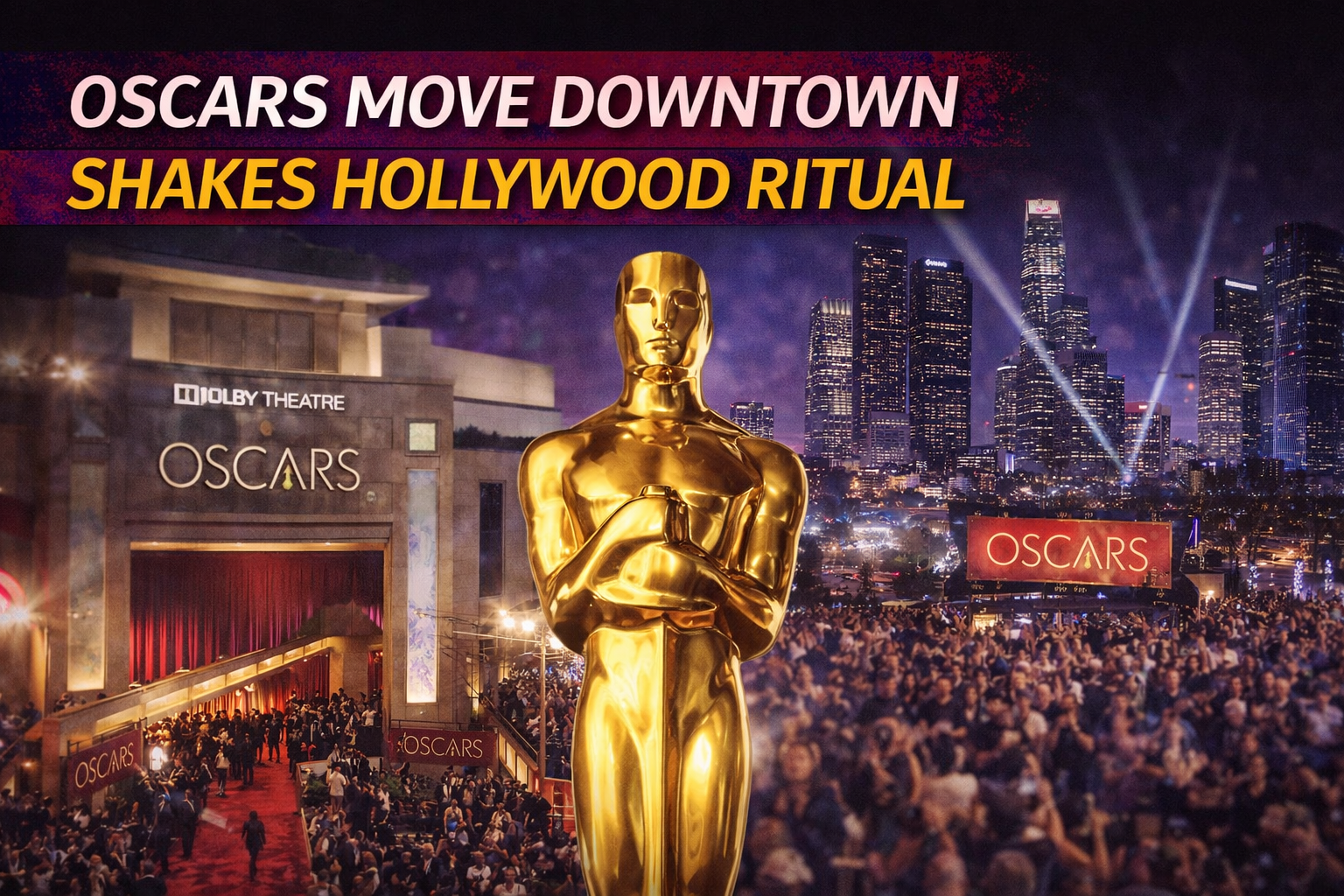
The Oscars will leave the Dolby Theatre after the 100th ceremony in 2028 and relocate to Peacock Theater at L.A. Live in 2029 under a new Academy-AEG deal that runs through 2039. The move also lines up with the show’s shift from ABC to YouTube, making this more than a venue change.
What we know / What to watch:
The 100th Oscars in 2028 will be the last at the Dolby Theatre. Beginning in 2029, the ceremony moves to Peacock Theater at L.A. Live, where AEG says it will make major production upgrades. The bigger watch item is how the Academy retools the show’s identity as it also begins streaming on YouTube.
Oscars move downtown in 2029, and that shift is bigger than a simple real-estate swap. The Academy and AEG announced a new global partnership that will move the Academy Awards from the Dolby Theatre in Hollywood to the venue now known as Peacock Theater at L.A. Live, beginning with the 101st Oscars ceremony in 2029 and continuing through 2039. The 100th Oscars in 2028 will still be held at the Dolby, which means the Academy has now put a formal end date on one of the most recognizable venue relationships in modern entertainment.
The move matters because the Dolby Theatre did not just host the Oscars. It helped define the look of the event for more than two decades. The show has been based there since 2002, except for the pandemic-era 2021 ceremony at Union Station and the Dolby. Associated Press notes that this run turned the Hollywood venue into the visual shorthand for Oscar night, from the staircase shots to the tightly controlled red-carpet approach on Hollywood Boulevard. Moving the ceremony to downtown Los Angeles breaks that visual habit at the same time the Academy is trying to modernize the show itself.
The new site is not a random downgrade or backup room. According to the Academy and AEG, L.A. Live will become the new home of the Oscars starting in 2029, with AEG committing to upgrades to the stage, sound and lighting systems, lobbies, backstage areas and other production-critical spaces. The partnership also says the complex’s expanded plaza will host red-carpet arrivals and related activity. That suggests the Academy is not merely transplanting the ceremony; it is redesigning how Oscar night physically unfolds, from arrival shots to backstage flow.
This is where the culture angle sharpens. For years, “the Oscars” meant Hollywood in the literal sense: tourists, barricades, boulevard glamour and the mythology of the film capital showing itself off. A downtown move changes that symbolism. AP notes that the Peacock Theater seats roughly 7,000 people and sits inside a larger event district with hotels, restaurants, open-air gathering space and direct adjacency to Crypto.com Arena. That makes the ceremony feel less like a sealed-off Hollywood ritual and more like a major citywide event built for live entertainment logistics.
The shift also lands alongside another major reinvention. The Academy announced in December that YouTube will become the exclusive global home of the Oscars starting in 2029, ending the ceremony’s long broadcast run with ABC after the 100th Oscars in 2028. Under that deal, the Oscars will stream live and free worldwide on YouTube, with additional language and accessibility features, while YouTube also takes on other Academy programming. Put plainly, 2029 is shaping up as a complete reset: new platform, new venue, new physical grammar for the show.
That timing is not accidental. The Academy’s venue announcement explicitly notes that Peacock Theater will be the first venue to host the Oscars once the show begins its YouTube era. That means the organization is treating the move as part of one larger transition rather than two separate business decisions. A streaming-first Oscars likely needs different camera logic, crowd flow and fan engagement than a broadcast-era Oscars did. L.A. Live gives the Academy more room to build those pieces than the boulevard setup allowed.
There is also a historical loop here that gives the story more weight than “Oscars leave Hollywood” headlines alone suggest. AP points out that the ceremony has lived in downtown Los Angeles before, including long stretches at the Dorothy Chandler Pavilion, and has also been staged at the Shrine Auditorium. So this is not the Academy abandoning its past so much as returning to an older civic geography after a long Hollywood phase. The difference is that the downtown it is moving into now is not the old formal downtown of mid-century awards culture. It is a branded entertainment district built for multiplatform spectacle.
That distinction matters because the modern Oscars are no longer just a ceremony for the room. They are a global image machine. The Academy and AEG both framed the partnership around scale, technology and worldwide audience experience. AEG described L.A. Live as a place “built to host the moments that define culture,” while Academy leadership emphasized collaboration around a global celebration of cinema. Corporate language can be fluffy, but the direction is clear: the Academy wants a venue that behaves more like a flexible entertainment campus than a classic single-house theater.
The culture tension underneath all of this is obvious. For some viewers, leaving the Dolby Theatre will feel like the Academy is giving up a piece of Oscar identity just when the show still needs prestige. The Dolby run gave the Oscars continuity, and continuity matters when awards shows are fighting audience erosion. But the counterargument is stronger than traditionalists may want to admit. The Academy is not protecting the Oscars by freezing them in place. It is trying to keep them culturally legible in a media environment that has changed harder and faster than the show did. The move to L.A. Live, paired with the YouTube deal, is a bet that reinvention now looks less risky than nostalgia.
There is a practical side too. Peacock Theater already has awards-show credentials, and AP notes it has hosted events including the Emmys and MTV Video Music Awards. That does not make it the Oscars, but it does mean the Academy is not moving into an untested room. It is taking over a venue already built for television-scale staging, then tailoring it further. In entertainment-business terms, that is a more rational move than clinging to tradition for its own sake.
The biggest unanswered question is what gets lost in the process. Hollywood Boulevard gave the Oscars a built-in fantasy of old-school movie capital grandeur. Downtown L.A. offers scale, flexibility and modern infrastructure, but it carries a different emotional charge. The Academy now has three years to prove that the 2029 version of Oscar night can still feel like the movies and not just another premium live event. That challenge, more than the address change itself, will decide whether the move feels visionary or merely efficient.
For now, the facts are straightforward: the 100th Oscars will close out the Dolby era in 2028, the 101st Oscars will open the L.A. Live era in 2029, and the ceremony’s YouTube future begins that same year. In culture terms, that is not a footnote. It is one of the clearest signs yet that Hollywood’s biggest night is trying to become something structurally different from the institution audiences thought they knew.